[The powerful finale from Greed, my favorite film]

Wednesday, August 11, 2021

Neeraj Chopra and Interviews

 I haven't followed javelin throw as a sport much over the years. My earliest memory related to the sport is my school sports day, where a student threw a javelin and nearly knocked off our sports teacher, Mr. James, and duly got a thrashing from him. I have followed long jump a bit, even high jump and discuss. Hammer throw and javelin have been sports disciplines I have ignored sadly, over the years. Not any more, I hope. 

After Neeraj Chopra's achievements, I went through some interviews on youtube to learn a bit about Chopra's journey. Big mistake. What I was expecting was some insights on the Olympic gold medalist. What I got were so many mindless questions. "Do you have a girlfriend?" One person advised him to cut his hair short a few months back so that it does not affect his throwing. His coach was also asked about it and he smugly replied that he looks good like this. 

An interviewer said that the girls are now head over heels about him. He promptly replied that he hopes such things do not go to his head and he always focusses on his job. One said that the medal belonged to the whole country and grabbed the medal hanging in his neck without asking him to show to the camera. The horror. You would think people would have some courtesy. 

These interviews had many short questions, and before Chopra could finish the answers, new ones came up. How would you compare your legacy to Milkha Singh, P.T. Usha? When Chopra said it is for the people to say, not him, the interviewer again urged him to answer what he thought about his legacy. 

Chopra answered all the questions genuinely. There is so much to learn and admire from an Olympic champion. Even if you do not know any thing about the sport, you can ask questions about the human story. Instead, all I saw was pompousness from these men and women from the media. Why not a long, relaxed interview where we let Chopra speak. 

Thank you Neeraj Chopra for bringing us so much pride and joy. 

Saturday, February 24, 2018

The Bald Patch


Seventy years ago, independence!
Hope, aspirations: New book stores
We read, we talked
Now, we have improved
Smart cities, smart online shopping, modernity
We will still have books
However, with a strand gone

The bald patch will remain.

Friday, December 7, 2012

Supermen of Malegaon and the Beauty of Little Bubbles


Supermen of Malegaon shows the craziness of film making. Malegaon is a small town which has muslims on one side, hindus on the other. Then, there are the people who have this other religion. They are the film making dreamers.

They want to make films, even if they don't know how to. The miracle is, they make the films and they are big hits in Malegaon and around there. They are remembered fondly. They have made Malegaon ke Sholay among other hits. Now they make Supermen of Malegaon.

This is essentially a making of the Supermen of Malegaon movie spanning a bit less than 60 minutes. There are a lot of things which keep going wrong. The camera drops into the pool, they don't have the necessary finances at times. They attempt to drop the Superman into the drain. A lot of comedy in different ways.

It is a lot more than just a making though. When Shafique Shaikh is selected for the role of Superman, the joy and elation in his face is real. The dedication of the people making the film in the little bubble is also very real.

Nowadays, a snobbish attitude persists. We see two traits in people and judge their entire personalities. Why can't we respect people for what they are any more? A hundred years ago, when cinema started, maybe it was made in this basic, rustic, comedic way like cinema is made today in Malegaon. Many years later, people might think the way the films were made today was ancient.

It is not about the processes though. It is about living in the little bubbles and enjoying the life for what it is, a pure joy, an experience. All the bubbles have their own beauty about them.

Wednesday, September 19, 2012

Barfi's Real Star is Jhilmil


 "The biggest mistake in life is to make no mistakes." - Said during the narration in Barfi.

In the first 45 minutes or so of Barfi, there are just a few glimpsed of Jhilmil, the character Priyanka Chopra plays. You can say that she is conspicuous by her absence. In the one substantial scene in this period, where Jhilmil is shifting homes, you can see that she is n afraid, timid girl. 

When she starts to join a song in a party, she is mocked. Perhaps, all her life till this time, she has been shunted and not allowed to grow. Jhilmil did spend time with her maternal grand father a fair bit too, so she wasn't completely dead in spirit, as it were. 

However, only after she spends time with Barfi does she start 'making mistakes', living and breathing. The fifteen minutes before and after interval when Jhilmil and Barfi spend time together are heart warming. The two have known each other since they were children. Only now does Barfi truly appreciate and realise Jhilmil in a way. 

Allowed to 'live', Jhilmil flutters and flies like the butterflies she is fascinated by in the woods. The differently abled people are as normal as any one else. In ways, they are more human as they are not polluted as much by the world which exists. They are human enough to pat goats in the head as Jhilmil does, not turn a blind eye like when we do when we see cows or horses being tortured on an every day basis. Priyanka Chopra was great in the role.

Set in the 70s, the film feels like a dream. It is as if you have been transported into a different world which we failed to notice and appreciate. Once you realize that, you start appreciating the differently abled even more so as normal people. That is all that is needed, really, for starters. 

Other pointers -
  • In the final scene, when an old Jhilmil is shown, she has an assured look to her in contrast to the 'able' Shruti played by Ileana D'Cruz, who has had a fractured life emotionally. Barfi and Jhilmil, one dying, the other, still very much autistic, need to give her support by touching her with their hands. Barfi and Jhilmil have lived normal lives. Barfi grimaces like most normal husbands would do perhaps when asked for a miniscule distracting task by Jhilmil while he is working in his old age. 
  • Ranbir Kapoor and Ileana D'Cruz have been superb. Without uttering a word, occupying the screen the most, Ranbir didn't make you feel words were lacking. Was pleasantly surprised how well Ileana, in her first bollywood film was able to emote facially, but then she has done many South films and is a star there.
  • Anurag Basu has made a perfect film. I disagree that in parts the film was slow. The casual flow added to the flavor. This is a warm broth to be relished sip by sip, not gulped down in a jiffy. For me, this is the best hindi film of the last 10 years or so.
  •  Earlier, Anurag Basu made Kites, which I liked despite elements of masala in it. Basu says the film was made 'democratically'. Earlier in the year, another excellent film, Kahaani was released. That was directed by Sujoy Ghosh, who had earlier directed the terribly Aladdin. Amitabh Bachchan, whose own son acted in Aladdin, said on twitter after watching Kahaani, what Sujoy was doing making films like Aladdin. It is amazing what happens people are allowed to flow.
  •  This film has repeat value for the film being as great as it is. However, you can watch it again the see more pointedly the homages which were paid to Buster Keaton, Chaplin and silent era in general. Barfi sleeping on the statue while it was unveiled is a tribute to Chaplin's City Lights, for instance.
 Update: Many portions of the film was lifted. While it does not mean the film wasn't good, it does take the sheen off a fair bit. Similar to after Black. 

Monday, January 23, 2012

Tree of Life and Why I Loved It

The Tree of Life has been unanimously acclaimed as the best film of the year in almost all critics polls.

Terrence Mallick makes one film every 5-6 years and his films are big events even by Hollywood standards. It was one of the most anticipated films ever among serious film goers. Even 12-18 months before it was released, people were talking about what it might be.

Coming to why I loved the film brings forth the real reason why I love watching films: They bring to you new experiences which take your breath away. A lot of the times, the arguments for artistically inclined films have been about greater meanings than plot essentially. It was all irrelevant here.

The biggest credit for the film is how many memories of a life growing up it brings back. Siblings playing together, the mother reading from a book to the child, the child asking the mother which of the children she loves most, the children playing with the water hose pipe. Stuff like that.

And then, it is absolutely beautiful to watch. The twenty or so minutes which has shots of the universe forming are so brilliant, you get a rush of blood and are charged up by the time the sequence is over. Each shot is like a painting which you can post in your drawing room. Isn't life like that too? It is beautiful. It should be cherished.

The film ends with a message of love and it is indeed what one should aspire to give in this world. This is truly a great film.

Tuesday, January 10, 2012

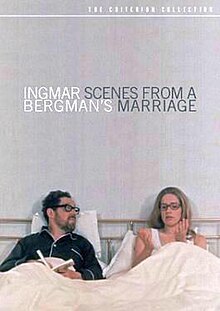
My Issues With Scenes From a Marriage

Scenes From a Marriage, the 5 and half hour television series, which became so popular, it was later condensed to form a feature length film, is widely acclaimed as a masterpiece. I didn't like the movie much though.

Firstly, as a piece of literature, it is brilliant. Liv Ullmann, who plays the female character, says in an interview in the special features of the Criterion disks that Bergman would never let any one tweak even minor things in his script. It had to remain as was written. They could improvise in expressions and acting but not in dialogue. It made me think, why not? You don't change what Shakespeare wrote when enacting it, even though the spoken language has changed. Why not Bergman. His script has the highest level as far as depth of dialogues go.

Coming to why I didn't like Scenes from a Marriage. Firstly, my biggest problem is that Bergman seems to have brought all the insecurities of a married life into this film. It is as if he jotted down the insecurities which could happen in a marriage and brought them all out. What was missing were scenes where they appreciated things which they did like about each other. There must be a few things. Maybe they did do it in the later film Bergman made, Saraband, where the two get together after many years but I missed it here.

The second aspect is the dramatic change which occurs. In the first scene during the television interview, the couple seem happily married. Then, the scene of conflict between their couple friends occurs and the sudden realization occurs that they cannot live on like this. This is where I disagree strongly. I believe things cannot go on suppressed for such a long time without any scenes of conflict and mutual realization that things are not that good after all. The first scene gave the impression that they couple were living a lie and despite their frustrations, they didn't realize the trouble living together was causing the other person in the relationship. I think couples do realize this with repeated issues which crop up and despite it you live together.

The third is a selfish reason more than any thing. The movie deals with what happens after the marriage of the couple breaks. Yet, it is named Scenes From a Marriage. What I would have liked to have seen is how the couple spent the 10 years together, living in sadness and anxiety. If Bergman had written that, I think it could have made a great movie by itself. This is purely a personal miff.

I did enjoy watching Scenes From a Marriage though. The five and half hours passed very quickly and you just couldn't stop watching. You want to see much more of Bergman after you see this. It is not for nothing that he is called a master.

Tuesday, December 6, 2011

A Separation


The latest masterpiece from Iran, Asghar Farhadi's A Separation shows how terribly complex the Iranian society is. In that, it is honest and true. Not every one would be interested in what happens in Iran though. What makes this film great is that it could have been a story about Kashmir or Afghanistan or even late 18th century France before the French Revolution.

Usually, a situation of crisis is shown with crafty story telling techniques. If you want to show how the British were terrible when they ruled India (as many films pertaining to the freedom struggle tend to show), you show some of them beating feeble Indians or some one sporting a nasty look like Captain Andrew Russell in (the wonderful) Lagaan. It pushes forward the story but is often manipulative, or the easier route.

Focusing on just a family or a small number of people is also nothing new. From art house films to hollywood blockbusters like The Titanic, all have done it. However, it is usually done with some strong back ground scores or losing objectivity some where down the middle. Again, to forward the story, easier ways are adopted.

There is little dramatic affect in this film. The first scene establishes the two want to separate because of not any domestic hostility or because of each other but they do want to separate because Iran is not viable any more for the mother to bring up her child and the father cannot leave his own ailing father. It is daily, real and yet not overtly dramatic situations like these which are highlighted. Financial and social constraints means a wife lies to her husband for not any devilish intent but because she wants to earn money.

The second, more poorer family shown has the man very agitated a lot of times. The scary part is the male protagonist in the film, Peyman Moaadi playing Naader, could become like this other family in 5-7 years time emotionally and financially as laws prevailing are redundant enough to enforce fines or be behind bars as it does on Naader despite no real faults of his.

Where the people's freedom is curtailed by imposition of too many religious, social and every other rules, their life keeps deteriorating if they decide to live on in that place. Some, like Naader can't leave though.

The separation of a family for no real fault of theirs leaves an impact. How many such families have been separated? How many more people have go to hell daily as they try to lead normal lives? It is a point well established through the film.

A Separation is Iran's Nomination for the Foreign language category for the Academy Awards. With Iranian directors Jafar Panahi and Mohammad Rasoulof jailed in recent times, this film gains special significance and I wouldn't be surprised if it wins the Award itself. It could easily win on merit itself though given it is far better than some of the previous oddball selections the Academy tends to pop up in this category.

Monday, December 5, 2011

When Style Was Celebrated

Dev Anand is gone. So is Shammi. There is another, silent death though, which has occurred slowly but surely. As Indian cinema, certainly bollywood, aspires for more realism, the style icons of today's generation are  scoffed at by the classes.

When and why did this happen? If we look to the 70s, some one like Shashi Kapoor was appreciated. Amitabh Bachchan is often criticized by the film people of his generation for not doing more classy films. Note for instance this video of Naseeruddin Shah where he observes Bachchan made no great film, for what's it worth. While this can be argued and debated upon, what cannot be argued is that Bachchan was real in his acting. You could feel his pain in Kabhie Kabhie, his anger in Zanjeer and his honesty towards his craft in his comic capers for instance.

Was it Bachchan then from where the shift occurred in appreciating style like we used to? If Govinda and Salman Khan were from another era, would they, along with selling tickets, be given more love and not scoffed at for their mannerisms? I wonder.

Friday, December 2, 2011

The Lack of Standards on Indian Television

Sex sells. So I am not surprised the promotional of The Dirty Picture, biopic of Southern star Silk Smitha is suggestive. I am fine with that in fact. My qualm is with the standard of Indian television not being regulated enough. I am not sure there is any standard to be honest. As far as India is concerned, the only taboo is nudity on television and film.

Every thing else is fine. Whether it is models and actresses dancing like bar girls would dance in a night bar in Mumbai or violence or cheap jokes in the name of comedy in 'laughter shows', which never tend to bring laughter. If any voice is raised, like the censor board tried to stand up and remove the word 'saali' from the movie title Yeh Saali Zindagi, a ruckus is created about freedom being curtailed.

18, even 15 year olds are fine to decide but children below 10/12 years are impressionable. There has to be acceptable standards and clearly demarcated rules beyond nudity. We live in the internet age but the internet is for the parents to regulate.

What one hears on the radio or sees on the tv cannot always be regulated by parents though. Aamir Khan has to be appreciated here. He made a film on toilet humor with a lot of slang words in Delhi Belly. However, in the promotionals for his film, he made people aware of what it was and did not use even one abusive word without the beeps. It served the dual purpose of promoting the film and letting sanity prevail.

Live bathing, Iss Jungle Se Mujhe Bachao
It is left to producers and distributors of the films and shows regarding how the show the content on television. We need an overhaul and stronger regulations though as television reaches far more people than a movie does. People go to a movie theater once in a while but most families watch the television on a daily basis.

The scenario is unlikely to change without some powerful people from the business itself  understanding the importance and taking firm action as an industry as a whole.

Saturday, November 12, 2011

Iti Mrinalini and the Uncertainties of Life

Iti Mrinalini gives us an insight into the life of an aging actress and into the world of bengali cinema just like Sunset Boulevard did in an era past. The aging actress is no longer wanted and after a life which has had so many shadows, you do not see any light at the end of the tunnel, even though you want to.

As the film encapsulates an actresses life, you get a feel of a bygone era of Kolkata where troublesome elements are shot to be shut off by the authorities. You have many performances worth cherishing like by Aparna Sen (who also directs the film), Konkona Sen, Rajat Kapoor, Priyanshu Chatterjee and Koushik Sen.
 
The film is more about the concept Aparna Sen tries to bring forth though than the any thing else. Life is uncertain and one should accept that. It is a simple theory at heard which we all know. However, in our mind, we some how make safety nets. One should realize that no matter how strong the safety net, it can all fall apart and we can do nothing really to prevent things beyond our control to occur.

This is not to say we should not try to do what we can to enrich our lives. However, believing it will ensure every thing will be great, or even to expect every thing to be great always is a major folly at the core which will lead to nothing except depression and anxiety.

The film is very sad but it is so to put across a point and it is important to realize this. This is a great film and I recommend you watch it.

Monday, January 31, 2011

Dhobi Ghat - Themes

The divide

From Raj Kapoor and Nargis in Awaara to Aamir Khan and Karishma Kapoor in Raja Hindustani, love between a rich girl and a poor guy is a recurring motif in hindi cinema. Dreams, magic, any thing can happen on celluloid. Love knows no boundaries. So they say.


Life is not like that though. There is a divide which is evident from the different utensils the maid gives Munna and Shai when serving them tea to the way the friends of Shai joke about her hanging out with him. Munna standing on the road while Shai leaves in her car is a recurring event in the film. Even when Munna joins Shai in the car, the divides are evident. Shai wants to take Munna's porfolio shots (as he wants to become an actor) out in the open but Munna wants them in the studio.

Voyeurism 

Shai shoots Arun while Arun is looking at Yasmin's videos. Love, Sex and Dhoka explored this theme in much more detail. The voyeuristic nature of our society is quite sad. As soon as you are interested in some one, you check out more info via google, facebook.When you encounter the person in real life though, like Shai sees Arun on the road, they try to hide away. 


Unrequited love - A constant and most obvious theme in the film. I am always glad on the rare occasions when some one shows it on celluloid like in Kabhie Haan Kabhie Na, Darr, Saawariya and of course Devdas. There is a deep grief about unrequited love which is probably why it makes for great cinema.

The breaking of families

Aamir is disconnected with the real world all the time. However, when he hears the possibility of going to Sydney, he becomes alert. He probably longs to see his son all the time. The old woman is some one whose children have left her on her own in all probability. I see a lot of older people being abandoned. I used to visit an old home till a few years back and it is heart breaking when you talk to some of these people.

The Daily Grind

The day job of Munna is not enough. He has to kill rats at night to make ends meet. Munna idolizes the leading man Salman Khan. He has dreams but as responsibilities crush him, all he can think about is how to earn money. Any small role to make ends meet will do for him.

A lot of people haven't liked this film which is okay as it isn't a movie for every one. However, when you talk with people who have indeed liked the film, a lot of people say it is beautiful. When you look at the photographs of the people, it is indeed quite beautiful to look at. However, their life is a mess. Like Munna, they are trying to make ends meet, or are emotionally scarred like Arun, or even have had their lives destroyed like Yasmin. Munna asks Shai why she is shooting the common place Mumbai streets. "Why are you doing this?", he asks? "All is dirty here." For Shai, it is all very lovely from the outside. There is nothing beautiful about the stark, harsh realities of life though. 10/10.

PS - On Kriti Malhotra's performance- She was the soul of the film. Delectable in her potrayal of the innocent and full of love Yasmin Noor.

Sunday, January 16, 2011

Guru Dutt's Directorial Debut - Baazi

Guru Dutt's directorial debut venture, Baazi, flatters, shows a lot of promise but deceives in the end. The film starts with Guru Dutt shown sitting on the porch and looking like a man who has failed in life. He is probably the man who has lost out in the world of gambling after going to the dark side. A forewarning, a sign of things to come perhaps.

There are lot of things which are magical about the film. The young girl kissing Dev Anand's hands before he rolls the dice for luck, the elements of noir (there is actually a shot of a lamp post which thrilled me no end). By the time the Tadbeer Se Bigadi Huyee Taqdeer song plays, you are gushing and have smiles all over. That is the high point of the film, however.

The plot becomes pretty hotch-potched after that. There are a fair few songs which keep popping up as well which not only disturb the narrative, they aren't that great mostly either (a huge disappointment for a S.D.Burman fan like me). I really loved the choreography of the song where women dance with umbrellas and rain coats though. That was some thing new.

The direction is excellent though. Guru Dutt shows he knows his craft. There is a song where Dev Anand has to come home after the heroine's father has thrown him out of the car. There are shots of common folk shown and they are going about their daily work.


The acting through out is excellent. Dev Anand is neat and plays the leading man with panache. He underplays quite a bit. Kalpna Kartik, who went on to marry Dev Anand in real life didn't have a very successful career as an actress. I loved her in this film though. She has a deep, husky voice and adds a lot of sensitivity to the morally upright character. People talk about Dharmendra's iconic scene in which he went shirtless. It is supposed to be the first instance of a bollywood star going shirtless. Not true. Dev Anand is shirtless in the film and the scene is far more sensuous than the Dharmendra scene according to me. That scene has an element of raw sexuality. This is far more subtle and all the more sexier for it. Dev Anand is in a situation where he is without a shirt outside his house. He tries to poke his elder sister to give him one without Kalpna Kartik seeing him. Kalpna Kartik notices him, takes the shirt and goes out of the house to give it to Dev Anand. Ahead of it's time much?


Geeta Bali is the star of the film though. She has a small role but shines bright. Even the smaller roles, the father of Kalpna Kartik, the actor who plays Pedro and others, some of whom are there in only a couple of shots seems interesting. There is a cameo played by Johnny Walker for instance and I laughed out loud with the first sentence he uttered. That's why Johnny Walker was so special I guess.

The murder scene was very well shot. All through the film, there are people smoking, smoke flying across the screen as a result of it which sets the mood. There is even a scene where Dev Anand puffs right into the face of Kalpna Kartik.

The film could have been far better if edited well but it doesn't fail to give us a peak into the fountain of talent which is Guru Dutt.

Thursday, December 23, 2010

Black Swan - The Degeneration in Pursuit of Dreams


(A very long piece ahead. The review contains a fair few spoilers to express regarding the points I think Aronofsky tries to make)

I didn't think much of Black Swan immediately after I had watched it. The more I thought about it though, the more I understood it and started appreciating it. Black Swan is about what artists go through, mostly emotionally and internally to create art. It is a psychological piece with great depth and is multi-layered.

In the second scene, we get a peak into the life of Nina Sayers played by Portman. She wakes up and gets in her routine of exercises. There is an innocence about her in her dedication and sincerity to her art. Not much seems wrong with her. We, as a society, appreciate people who are devoted to their art/profession, particularly those who manage to succeed. However, we do not realize what goes into creating hard work which also results in success.

The success part is indispensable. In the Gita, it is written that one should keep doing one's job without caring for the result. However, in life, you tend to up the stakes so much that you cannot live without success. Nina's mother says to her that she should be selected as she has been there long enough and is 'the most dedicated dancer in the company'. It obviously highlights that time is running out on Nina (and thus the obvious pressures of that). However, it also looks at the crux of the proeblem. Success is not always in your hand or dependent on how dedicated you are or how hard you work or even how talented you are. Ability is a prerequisite of success and you can hone your talent and become the best in the world. However, even if you are the best in the world (it is a highly subjective thing I might add, there is no unanimous 'best', it is some thing which is dynamic and highly subjective), you need opportunities and the people in power need to provide you with that opportunity.

Nina talks about having dreamt the previous night that she was dancing the White Swan. She even remembers the steps she danced in the dream and says it was a different choreography. This is what her life is all about. It is the ONLY thing her life is about. From time immemorial she has dreamt of being perfect.

It is very symbolic and poignant that she dreamt of being the White Swan and not the Black Swan. From her childhood, she has dreamt of being a great ballerina and what draws her to it are the good (white) aspects. It is an outsider's view when you are a child and dreams are formed. At that stage, you don't know about the bad (black) aspects. As Cassell, playing the director of the show tells Nina, she plays the white swan very well but it the part of the black swan which she has to play well.

From that innocent childhood of dreams and ambition, Nina eventually turns into a black swan. In all the psychological assault which Nina takes, she doesn't lose focus of her dream. While she is dying in the last scene, she is joyous that she has finally achieved what she has strived for all her life - perfection in her art.

All through the movie, we see the insecurity an artist has. Earlier, Nina wants to get the part. When she gets it, she is constantly worried some one will take it away from her. The first thought which comes to her mind when she wakes up from sleep is that the part may not remain with her. Even between acts in the final performance, she hallucinates that Lily (played by Kunis) is getting ready and will snatch the part of the black swan from her. She imagines that she has kills Lily. It is again symbolic - when you are the Swan Queen, you kill many such Lily's.

There are other artists shown. Beth (played by Ryder) has seen the baton pass and we see what an artist who is past the glory days go through. A performer like a ballerina or a sports person has a very small prime life. All through life from a very young age, you try to learn one thing and you know nothing else. A lot of times, you don't even reach the stage of huge success. This is why these people dread retiring and want to carry on as long as they possibly can. You saw Michael Jordan do it and now Schumacher is doing it. No one really wants to retire as they don't know to do any thing else.

I once met a former Indian test cricketer who wasn't very successful at the international level. He told me with deep regret that he never gave importance to studies and would advice every one to finish their studies. He was playing domestic cricket at the time which gave him very measly sums but in a few years, he wouldn't be getting even that given that he hadn't really learned any thing all his life. You see even successful people like Portman and now some one like Emma Watson give priority to their education which is a very wise decision.

There is lot of sexual scenes in the film which has caused intriguing debates about whether female sexuality was potrayed in a manner which is essentially voyueristic and in a manner which is essentially gratification for the male audiences. There is also the view points regarding sexual repression. I really don't think the sexual scenes were about the sexual aspects at all.

Firstly, Cassell exploits Nina sexually in the film. He kisses her without consent, gropes her and forces himself on her more than once. I don't think he did it for the sake of getting any great performance out of Nina at all. Also, it is not some thing you can justify as it is essentially sexual abuse which is a crime. It is reprehensible and should be condemned in the strongest words.

A lot has been made about Cassell telling Nina to touch herself a little. I don't think he told it with any great plan of creating artistic performances from Nina. It might have been a small fantasy of his which he uttered out aloud and not much more. Nina though, to perfect the art, is willing to try every thing. When she is masturbating, she envisions her mother sitting on the chair and is petrified. At another time in the tub, she sees a horrific face emerge. These are signs that she may not really want to do these acts and may even want not to do them but does them as Cassell has told her and she believes it might improve her art. It is another step from the white to the black. The taking of drugs, the lesbian scenes are all extension of going to the dark side. Nina, for all it is worth, is straight. There is no indication that she has lesbian inclinations but she wants to keep Lily happy and is willing to do any thing for it. That she wants to keep Lily happy would show that she is at a heightened state of insecurity - at this stage the natural reaction is to try and keep every thing calm and every one around you pleased and not to ruffle them even in the slightest.

Lily of course never did have any lesbian action with Nina as it is evident from the next day when Nina confronts Lily. Lily is depicting an artist at an extremely innocent and initial stage of the degradation of the artist in the film. She is some one who looks up to Nina. When Nina gives a great performance, she goes to Nina's room and personally congratulates her. She is genuinely delighted. She wants to be a great ballerina like Nina but hasn't been exposed to the darker aspects of the art yet.Of course, as she wants to be a great ballerina, she is already trapped in the wormhole and it is a matter of time before she gets completely sucked in.

The character of Nina's mother is also a statement on another aspect of an artist's life. Nina's mother is a former ballerina who wasn't successful. She is a pyschological mess and has planted her dreams in Nina. She gives idealistic garbage talk to Nina which raise expectations which she knows are far away from reality. She tells Nina that she should be selected as she is the most dedicated dancer in the company. You see the scene where she reacts very weirdly when Lily comes to her flat to talk with Nina. She first tell's Lily that Nina is not home and then constantly tells Nina to come back to the flat as it is late and she ought to sleep. In frustration, Nina takes off from the flat. She tells her mother at one stage that she is an adult now and no longer a child. We don't see Nina having any friends or a social life in the film. She has essentially been cut off from the world by her mother from early childhood. She hasn't really had a child hood. The parts where it is shown that the mother is stopping Nina from going for practices is an imagination of Nina according to me. By that stage, Nina is consumed by her dream and she thinks the whole world, including her mother, is against her. She essentially finds herself alone, fighting a solo battle. The way the character of the mother is structured in the first half of the film, she wouldn't behave in a manner to stop Nina from playing the White Swan. That it is imagination is strengthened by the fact that she never really does manage to stop her. Even when she locks the door, Nina magically finds the keys and is free.

There is a lot of physical aspects too which are very interesting. A portion of Nina's back is always tearing apart and blood is coming out of it. Her nails keep breaking with more bloody scenes. She is breaking up emotionally and she sees it though a breaking up of her body. When you look at Nina's face all through the film, it is strangely stressed and neurotic. It is as if she is in a state of constant heightened tension. Amazingly potrayed through the images and the performance of Portman.

When you are insecure, nervous and fearful, you imagine the worst. Nina imagining her legs breaking is a reflection of that. It is also probably because of constant physical pain that she fears it because of the physical assault her body has been put through all of Nina's life. Close ups of the feet balanced on the toes while dancing are shown a few times. She is also shown going to the doctor who examines her ankles. This are just brief moments where the physical aspects of the perils of art are shown. This is examined in a lot more detail in The Wrestler. The careers are over by the time you are 30-40 depending upon your art. Artists and performers destroy their body by that time though and are in pain all through their lives. I remember an interview with India's most successful test bowler with Harsha Bhogle after a successful tour of Australia. Bhogle asked Kumble enthusiastically how long he would play. Kumble said that his shoulders hurt every day because of constantly bowling and he cannot carry on for too long. That was a pretty sad. What is sadder is that Kumble is still continuing in the Indian Premier League a fair few years after that interview. Not begrudging him playing (and he is doing well) as a sportsperson's life is short and the more you can extend it, the more money you can make in that short span, the better it is for them.

Coming back to Black Swan, it is a very tragic piece and commentary on the pyschological transformation an artist goes through while seeking that elusive glory. It is true not only about artists but is true in any field. A lot of people lose a sense of the larger picture in pursuit of the goals they set themselves. A lot of people live with a false sense that the world revolves around them. While dedication and hard work to achieve a goal is great, you have to enjoy the process. Life is all about cherishing each moment you have in this world. It is not about living in constant emotional turmoil. Can one achieve huge success without losing one self in life or in art (specifically as this movie is about art)? It is a tricky one but first you have to decide whether you want to lose yourself in pursuit of your dreams or not.

The more I keep thinking about the film, I keep coming up with more points and facets. The film's greatness keeps increasing. This is a film which touches on a lot of points and has a lot of depth and layers. It is a masterpiece. 9/10.

PS - I didn't really talk any thing about the haunting, disturbing and great score, the direction or the masterful way in which the film is made. It is a work of masterful craftsmanship from the point of view of film making. Even if you don't like the film at all, you can't take way that from Aronofsky.

Monday, December 20, 2010

Dogtooth

Not a lot of movies shock me. So I was quite surprised the unsettling impact Dogtooth had on me. A father locks up his 3 children who are in their late teens - early twenties in a large house and they have stayed there all their lives.

The three children are told lies of various degrees. Living totally isolated from the world and in a manufactured universe, they do not react like normal people would. The lack of awareness and exposure makes for very interesting scenarios and reactions.
 
The film can be pondered upon on several levels. For instance, governments never really tell their people any thing close to the whole truth. Thoughts on these lines - the harms caused by leaving people in the dark are the obvious things one can take back from the movie.

I am very interested in the alternate viewpoint of the parents though. They genuinely thought exposing the children to the world would be harmful for them. While that is not some thing one can possibly agree with, there are some positives which do come out of it in my opinion. For instance, when one of the girls who has never having been exposed to popular culture, dances (see video on youtube here), she creates some thing unique. As she has not seen any thing before, she is not influences by any thing and creates her own style. That is a positive in my mind.

This is film which is close to a masterpiece. When the film had released, it was panned in The New York Times and received an average review from Roger Ebert.  I am quite pleased then, that it is slowly getting appreciation and is ending up in a few best of the year lists as well. This is a must watch according to me. 8.5/10.

Thursday, October 14, 2010

Uttam Kumar Film Festival

From The Telegraph India -

Uttam Cinema Utsav organised by Nandan and Bengali Film Lovers Society in association with Tapan Sinha Foundation. Noted film personalities will be present on the occasion. Satyajit Ray’s Nayak will be screened as the inaugural film in a week-long festival of films, starring Uttam Kumar.
Pretty excited about this. Should be awesome watching the best films of the actor Uttam Kumar.

Friday, May 28, 2010

Two Excellent French Contemporary Films

Both the films were on my 21st Century TSP list and I watched them sequentially by co-incidence.

Caché

Thriller-drama putting across the message that the deeds of our past may come to haunt us any time in the future, you never know. This is a film about conscience and explores how people often forget the small yet significant deeds they have done in the past which may have changed some one else's life drastically. The protagonist earlier never feels any thing on his conscience but is made to feel a burden on it by the end of the movie in a very dramatic way. 7.5/10.


Summer Hours

I absolutely love this movie. It is about how modern day life is splitting families apart. Three siblings now live in three different countries. The mother might pass away soon and what to do of the family heirlooms and house is a question which needs addressing. The grand children don't feel particularly attached to the heirlooms as they show no interest in the paintings. The last two sequences of the film sum it up. In one, the caretaker of the family house is bidding her own son goodbye and awaits meeting him in next September summing up how life is in the modern world. In the last scene, grandchild mulls over her grandma with her boyfriend in a particular place where the grandma used to come with her boyfriend. This is a movie which pans generations and is about the 21st century way of life where families are families no more. Criterion has released a disk of the film in March, 2010 and I urge you to see this one. It is an absolute masterpiece. 9/10

Thursday, May 20, 2010

Ordet - Perfect


Ordet is a movie about faith. It really questions the faith we have to the extremest measures possible. Men and women of various levels of faith are shown for instance there is the man and wife, the man being a non believer while the wife is a believer 100%. Then there is the father who hopes he has faith but doesn't know because he is again, tested extremely because of his mentally ill son.

The movie seemed ok for the better half but I wasn't getting the concept of faith totally which Dreyer was trying to put across. Some where around the mid point of the movie, I would have thought I would give this movie a rating of around 5. It slowly shifted to 8 as the movie treaded along. Fifteen minutes after I had watched the movie, I finally got the concept exactly as the director was trying to put across and the movie seemed perfect to me.

It is a great piece of art. I don't think it is possible to depict the concept of faith any better than this movie has done and thus I give it a rating of 10/10. This movie is timeless.

Sunday, January 31, 2010

Road To Sangam - Best Gandhi Film I have seen


*this review contains no spoilers*

I went to watch Road to Sangam only knowing that it was a film with a connection with Gandhi and had won some awards. What transpired on the screen in the next 135 minutes changed my perception of Gandhi and changed me as a person. I am some one who did not regard Gandhi in the high esteem a lot of people regard him in. He, to me, was some one who was adamant and threatened the nation with his blackmails which were carried out promptly by his followers. What I did not understand was that it was the power of Gandhi's thoughts which made people act the way they did. It had reason, it had logic.

Coming to the film. We are given a rationale and the film makes a strong case for it. You almost start believing in the thinking behind it. Then, there is a slow process of change which is so slow and gradual. It is not some thing which happens right away or through a flash bulb of genius. It is realization in process. The way the change is shown is convincing enough for some one to believe in the Gandhian principle.

The film has many layers to it. It is a film which asks 'what defines Karma'. It is a film about holding upright the faith Gandhi showed in the muslims of India. It is a film about how a person be it a muslim or a person of any religion (or even an agnostic or atheist for that matter) should behave. That's the bigger picture.

Then the film touches on tough subjects like partition and the role of an Indian muslim. Many layers and subjects touched, all given due space.

Paresh Rawal is excellent in the role of a man who works based on logic and is principled at the same time. I can't think of a better actor to carry out the role. The part of a muslim from the state of Uttar Pradesh, perfect with the local accent, who has his own little mannerisms and characteristics is played perfectly. The facial expressions are not exaggerated. The lines are spoken with a calm balance about them, exactly how the character would say it.

The pace of the movie is neither fast, nor slow. It has it's own rhythm and flows rather than moves. The cinematography is excellent with aspects of small town India (the city Allahabad in this case) shown. There are panoramic views and then there is attention to detail. A man making aloo tikki is shown for instance to capture the flavour of the chaat which is so popular in small town India.

Coming to Gandhi films, I have seen quite a few. Gandhi was a great biographical sketch. Gandhi My Father shows the flaws of Gandhi - the father of his son. Lage Raho Munnabhai which was so popular tries to explain the Gandhi way of thinking and does a fair job of it. It has the bollywood masala mixed in it, was perfectly marketed and was a huge success. Gandhigiri became a trend. Sardar, again starring Paresh Rawal (as Sardar Patel), paints Gandhi as a principled, yet stubborn man whose will might have cost India There are umpteenth movies which are presented as documentaries on Gandhi, most of which are holistic. No movie portrays Gandhism, like Road To Sangam does. At least none I have seen.

The show I went for was almost canceled as only one other person showed up at the ticket counter. In the end, just five of us came to watch the movie which they did screen thankfully. One engineer who had studied from Allahabad itself remarked that Gandhism is dead as no one turned up for this movie. I remarked that Munnabhai was a huge success. So it is a marketing flaw and lack of funds which meant audiences didn't come to watch this film. There is another aspect to it. It isn't a masala flick like many other bollywood flicks or like Munnabhai. It is not boring in any way, mind.

I give the movie a perfect 10/10. Don't think it could have been made better.

Tuesday, November 10, 2009

15th Kolkata Film Festival Starts

The 15th Kolkata Film Festival started today with the opening film, The Boy in the Striped Pyjamas. I didn't go to see it as it is available on DVD and easily accessible. It is a part of an interesting series of films though - films by contemporary directors on World War II. All these films are from 2008 and 2009 and promise the 'outside view' on the war.

The film I am looking forward to most in the festival is India's Oscar nominated (for Foreign film category), Harishchandrachi Factory which is on the making of India's first film, Raja Harishchandra by Dadasaheb Phalke.

I plan to see contemporary cinema at the festival, mostly films from the last 3 years which are not easily accessible.

I will also try and watch the Indian Select films, notable among which will be the bengali film selections.

I am targeting viewing 20-35 films over the next 7 days. Much fun beckons. :)

Wednesday, May 20, 2009

Jukti, Takko Aar Gappo

Jukti, Takko Aar Gappo is a 1974 Bengali film by the acclaimed director Ritwik Ghatak. It is an excellent movie on the political situation in Bangladesh, Bengal and India on a whole to an extent at the time. Bangladesh had just become independent in 1971 and the movie was screened for the first time in 1974 - it has a female character who is called 'Bangladesh's soul'. Ghatak (named Nilakantha) plays the central character in the movie of a drunkard intellectual whose wife has no option but to leave him. Nilakantha goes in a journey to reach his wife.

During the journey, Nilakantha has experiences meeting new people and expressing his ideologies and thoughts on the world at large. He meets naxalites, Bengal's youth itself, with whom he has an intriguing conversation. Nilakantha disapproves of the youth's ideology, says that it is dying every where in the world and that it has no future. The youth doesn't take to Nilakantha's argument and terms him a decadent old drunkard.

The whole movie is a joyful tapestry of images. We see brilliant cultural dances and a cultural dancer muse on the decaying form of the art for instance. Ghatak, as the protagonist, is brilliant in his acting of an alcoholic man who has no one to listen to his ideologies any more and no one to turn to as his wife has left his side. He says every thing is burning, the universe is burning several times in the movie press on his view in short.

Jukti, Takko Aar Gappo gets a solid 8/10.