[The powerful finale from Greed, my favorite film]

Monday, January 23, 2012

Tree of Life and Why I Loved It

The Tree of Life has been unanimously acclaimed as the best film of the year in almost all critics polls.

Terrence Mallick makes one film every 5-6 years and his films are big events even by Hollywood standards. It was one of the most anticipated films ever among serious film goers. Even 12-18 months before it was released, people were talking about what it might be.

Coming to why I loved the film brings forth the real reason why I love watching films: They bring to you new experiences which take your breath away. A lot of the times, the arguments for artistically inclined films have been about greater meanings than plot essentially. It was all irrelevant here.

The biggest credit for the film is how many memories of a life growing up it brings back. Siblings playing together, the mother reading from a book to the child, the child asking the mother which of the children she loves most, the children playing with the water hose pipe. Stuff like that.

And then, it is absolutely beautiful to watch. The twenty or so minutes which has shots of the universe forming are so brilliant, you get a rush of blood and are charged up by the time the sequence is over. Each shot is like a painting which you can post in your drawing room. Isn't life like that too? It is beautiful. It should be cherished.

The film ends with a message of love and it is indeed what one should aspire to give in this world. This is truly a great film.

Tuesday, January 10, 2012

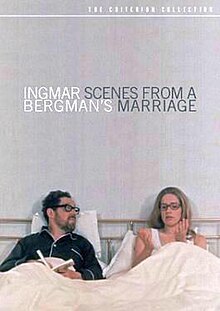
My Issues With Scenes From a Marriage

Scenes From a Marriage, the 5 and half hour television series, which became so popular, it was later condensed to form a feature length film, is widely acclaimed as a masterpiece. I didn't like the movie much though.

Firstly, as a piece of literature, it is brilliant. Liv Ullmann, who plays the female character, says in an interview in the special features of the Criterion disks that Bergman would never let any one tweak even minor things in his script. It had to remain as was written. They could improvise in expressions and acting but not in dialogue. It made me think, why not? You don't change what Shakespeare wrote when enacting it, even though the spoken language has changed. Why not Bergman. His script has the highest level as far as depth of dialogues go.

Coming to why I didn't like Scenes from a Marriage. Firstly, my biggest problem is that Bergman seems to have brought all the insecurities of a married life into this film. It is as if he jotted down the insecurities which could happen in a marriage and brought them all out. What was missing were scenes where they appreciated things which they did like about each other. There must be a few things. Maybe they did do it in the later film Bergman made, Saraband, where the two get together after many years but I missed it here.

The second aspect is the dramatic change which occurs. In the first scene during the television interview, the couple seem happily married. Then, the scene of conflict between their couple friends occurs and the sudden realization occurs that they cannot live on like this. This is where I disagree strongly. I believe things cannot go on suppressed for such a long time without any scenes of conflict and mutual realization that things are not that good after all. The first scene gave the impression that they couple were living a lie and despite their frustrations, they didn't realize the trouble living together was causing the other person in the relationship. I think couples do realize this with repeated issues which crop up and despite it you live together.

The third is a selfish reason more than any thing. The movie deals with what happens after the marriage of the couple breaks. Yet, it is named Scenes From a Marriage. What I would have liked to have seen is how the couple spent the 10 years together, living in sadness and anxiety. If Bergman had written that, I think it could have made a great movie by itself. This is purely a personal miff.

I did enjoy watching Scenes From a Marriage though. The five and half hours passed very quickly and you just couldn't stop watching. You want to see much more of Bergman after you see this. It is not for nothing that he is called a master.

Friday, December 23, 2011

On Don 2, Farhan Akhtar and a bit on SRK, PC

Don 2 promised a bit. Don, the remake by Akhtar was extremely slow but you could excuse it as it was a remake. Usually making a quality remake of a good film is pretty tough. In Don 2, Akhtar had the opportunity to experiment as there was no Don to bind him. Given the pedigree of Akhtar with Dil Chahta Hai and Lakshya, you would want to think he would create some magic at least.

What we see in Don 2, however, sadly is a good opening 20 minutes or so followed but mindless action, no real story and a movie which cannot be differentiated from the hazaar hollywood blockbusters. Action with a story line is okay but when you have repeated action scenes without any thing much at stake, you do not care about the action. The action itself is not very interesting. People fighting with hands mostly means it gets odious pretty soon.

The film is a bank robbery and I do not get how it is 'carrying the story forward', some thing Akhtar claimed when he started on the movie. This could have been any bank robbery film from any where. It could have been Italian Job or Inside Man, for all we know, though it was not as good as either. It could have been the recent Game starring Abhishek Bachchan produced by Excel, Akhtar and his friend's company for all we know.

One can argue the James Bond films didn't have plot similarities but this is a 3 movie thing by Akhtar and I would have liked to see it as part of a trilogy which stick together in storyline some how. The last 5 minutes of the film where the explain things is nice but it doesn't excuse for the boring tirade which precedes it.

On Priyanka Chopra - I am not sure why you need to keep on speaking with a sultry voice to try and appear sensuous. Angelina Jolie didn't need to do it any where and it looks desperate and is a big turn off. The idea of Chopra not killing SRK when she gets the opportunity as she might have developed a soft spot for him despite him killing her brother is cringe worthy to say the least. Their weird scenes are more vomit inducing than any incest, old man-young woman relationship which you might find awkward. While they are entering into a bank, SRK finds the time to ask her about her other relationship. Err, really?

Farhan Akhtar was some one I had high hopes from after he did Dil Chahta Hai, even higher hopes after he did Lakshya. However, as I have learned over the past few years, it takes more than 2 films to make some one a genius. Perhaps his directing skills have become weak because of lack of keeping at it or perhaps he has been lacking in ideas. I do not know what the reason is.

If I want to pinpoint, I would say he has terrible editing skills right now. This was evident in Don and even Karthik Calling Karthik. I know he didn't direct Karthik Calling Karthik but seeing the similar slow style with even Don 2, I am convinced about the editing aspect at least. He needs to sit down with Aamir Khan, who is a master editor, which would make a big impact I am sure. In the interval of Don 2, I saw the trailer of the Agneepath remake. Get some original ideas people.. I know the film industry is risky business but they don't call it a creative medium for nothing eh?

After Dil Chahta Hai, Akhtar was the director whose movies I looked forward to the most. Today, he is way down the pack. Anurag Kashyap takes his place and there are others like Dibakar Banerjee whose films I look to watch more.

Finally on SRK - He acted well and it isn't really his fault here but I wanted to punch him as he kept speaking and speaking and speaking. As Boman Irani said to another actor in one scene, shut up! His stocks are falling though as Salman Khan appeals with the masses and Aamir Khan appeals with the urban folk. Needs a bit of reinvention and let's see how he does on that.

Don 2 Rating - 3.5/10.


Tuesday, December 6, 2011

A Separation


The latest masterpiece from Iran, Asghar Farhadi's A Separation shows how terribly complex the Iranian society is. In that, it is honest and true. Not every one would be interested in what happens in Iran though. What makes this film great is that it could have been a story about Kashmir or Afghanistan or even late 18th century France before the French Revolution.

Usually, a situation of crisis is shown with crafty story telling techniques. If you want to show how the British were terrible when they ruled India (as many films pertaining to the freedom struggle tend to show), you show some of them beating feeble Indians or some one sporting a nasty look like Captain Andrew Russell in (the wonderful) Lagaan. It pushes forward the story but is often manipulative, or the easier route.

Focusing on just a family or a small number of people is also nothing new. From art house films to hollywood blockbusters like The Titanic, all have done it. However, it is usually done with some strong back ground scores or losing objectivity some where down the middle. Again, to forward the story, easier ways are adopted.

There is little dramatic affect in this film. The first scene establishes the two want to separate because of not any domestic hostility or because of each other but they do want to separate because Iran is not viable any more for the mother to bring up her child and the father cannot leave his own ailing father. It is daily, real and yet not overtly dramatic situations like these which are highlighted. Financial and social constraints means a wife lies to her husband for not any devilish intent but because she wants to earn money.

The second, more poorer family shown has the man very agitated a lot of times. The scary part is the male protagonist in the film, Peyman Moaadi playing Naader, could become like this other family in 5-7 years time emotionally and financially as laws prevailing are redundant enough to enforce fines or be behind bars as it does on Naader despite no real faults of his.

Where the people's freedom is curtailed by imposition of too many religious, social and every other rules, their life keeps deteriorating if they decide to live on in that place. Some, like Naader can't leave though.

The separation of a family for no real fault of theirs leaves an impact. How many such families have been separated? How many more people have go to hell daily as they try to lead normal lives? It is a point well established through the film.

A Separation is Iran's Nomination for the Foreign language category for the Academy Awards. With Iranian directors Jafar Panahi and Mohammad Rasoulof jailed in recent times, this film gains special significance and I wouldn't be surprised if it wins the Award itself. It could easily win on merit itself though given it is far better than some of the previous oddball selections the Academy tends to pop up in this category.

Monday, December 5, 2011

When Style Was Celebrated

Dev Anand is gone. So is Shammi. There is another, silent death though, which has occurred slowly but surely. As Indian cinema, certainly bollywood, aspires for more realism, the style icons of today's generation are  scoffed at by the classes.

When and why did this happen? If we look to the 70s, some one like Shashi Kapoor was appreciated. Amitabh Bachchan is often criticized by the film people of his generation for not doing more classy films. Note for instance this video of Naseeruddin Shah where he observes Bachchan made no great film, for what's it worth. While this can be argued and debated upon, what cannot be argued is that Bachchan was real in his acting. You could feel his pain in Kabhie Kabhie, his anger in Zanjeer and his honesty towards his craft in his comic capers for instance.

Was it Bachchan then from where the shift occurred in appreciating style like we used to? If Govinda and Salman Khan were from another era, would they, along with selling tickets, be given more love and not scoffed at for their mannerisms? I wonder.

Friday, December 2, 2011

The Lack of Standards on Indian Television

Sex sells. So I am not surprised the promotional of The Dirty Picture, biopic of Southern star Silk Smitha is suggestive. I am fine with that in fact. My qualm is with the standard of Indian television not being regulated enough. I am not sure there is any standard to be honest. As far as India is concerned, the only taboo is nudity on television and film.

Every thing else is fine. Whether it is models and actresses dancing like bar girls would dance in a night bar in Mumbai or violence or cheap jokes in the name of comedy in 'laughter shows', which never tend to bring laughter. If any voice is raised, like the censor board tried to stand up and remove the word 'saali' from the movie title Yeh Saali Zindagi, a ruckus is created about freedom being curtailed.

18, even 15 year olds are fine to decide but children below 10/12 years are impressionable. There has to be acceptable standards and clearly demarcated rules beyond nudity. We live in the internet age but the internet is for the parents to regulate.

What one hears on the radio or sees on the tv cannot always be regulated by parents though. Aamir Khan has to be appreciated here. He made a film on toilet humor with a lot of slang words in Delhi Belly. However, in the promotionals for his film, he made people aware of what it was and did not use even one abusive word without the beeps. It served the dual purpose of promoting the film and letting sanity prevail.

Live bathing, Iss Jungle Se Mujhe Bachao
It is left to producers and distributors of the films and shows regarding how the show the content on television. We need an overhaul and stronger regulations though as television reaches far more people than a movie does. People go to a movie theater once in a while but most families watch the television on a daily basis.

The scenario is unlikely to change without some powerful people from the business itself  understanding the importance and taking firm action as an industry as a whole.

Saturday, November 12, 2011

Iti Mrinalini and the Uncertainties of Life

Iti Mrinalini gives us an insight into the life of an aging actress and into the world of bengali cinema just like Sunset Boulevard did in an era past. The aging actress is no longer wanted and after a life which has had so many shadows, you do not see any light at the end of the tunnel, even though you want to.

As the film encapsulates an actresses life, you get a feel of a bygone era of Kolkata where troublesome elements are shot to be shut off by the authorities. You have many performances worth cherishing like by Aparna Sen (who also directs the film), Konkona Sen, Rajat Kapoor, Priyanshu Chatterjee and Koushik Sen.
 
The film is more about the concept Aparna Sen tries to bring forth though than the any thing else. Life is uncertain and one should accept that. It is a simple theory at heard which we all know. However, in our mind, we some how make safety nets. One should realize that no matter how strong the safety net, it can all fall apart and we can do nothing really to prevent things beyond our control to occur.

This is not to say we should not try to do what we can to enrich our lives. However, believing it will ensure every thing will be great, or even to expect every thing to be great always is a major folly at the core which will lead to nothing except depression and anxiety.

The film is very sad but it is so to put across a point and it is important to realize this. This is a great film and I recommend you watch it.